Showing posts with label "personal medical home" "Family medicine" cost quality "Health care reform". Show all posts

Sunday, August 2, 2009

What's In It for Me? What are our obligations to each other?

As what passes for a health care debate rages all around us, I have come to realize that between the polarized extremes there exists a very important group of people who are the key to what will happen this fall, and that is the large group of Americans who have health insurance and who are worried they may lose advantages in any reform. All of the noise in our media is an attempt to reach this group, who are likely asking, "What's in it for me"?

I believe that those who currently have health insurance and good access to medical care would be well advised to support proposed health care reform for the following reasons:
  • They may lose their insurance coverage! Right now, 14,000 insured people lose their coverage every day when they lose their job or the employer cannot continue to afford benefits, and that number is expected to increase greatly with current trends.
  • Business can't afford the increasing costs! Under the current system, costs are expected to double during the next 10 years.
  • Young people are priced out of the system! Those looking for work at the beginning of their careers are most likely to get jobs without benefits, leaving them uncovered and raising the cost for all others.
  • Insurance often does not work when you need it, even if you have it! The for profit system is full of people who work hard to "ration your care" by figuring out how not to pay for things.
  • The payment system must be reformed! Our current mess of a non system is caused by the payment incentive and lack of incentives we now have.
  • Quality is often lacking! A sad and poorly understood fact is that even people with good insurance get the recommended care they should have only about 1/4 of the time. The care is not organized in a way that allows most doctors to manage their patients the best way possible.
  • They may lose their doctor! Very few medical students are going in to the primary care disciplines, due primarily to the fact that they cannot afford to. Retiring family doctors are not being replaced. Reform which supports primary care is crucial to attracting the best and brightest into primary care.

When all is said and done, however, thinking just about ourselves misses one of the most important reasons for reform. Perhaps the most important thing to consider is, what are our obligations to each other? Our entire American society is engaged in global competition with all the countries on earth for the innovations, jobs, products and benefits of the world to come. We must have a society with well educated, healthy and productive citizens to secure the benefits of the future. Our companies need a level playing field that does not saddle them with the unequal and exorbitant costs of a failed system.

If the the future is scary to you, it is really not because of the risk of changing, but because we might not change. Don't be fooled.

Thursday, March 19, 2009

What does the Nation Think about Health Care Reform?


In December, the Presidential Transition Team invited Americans to host and participate in health care community discussions, and the employees and staff of Family Care Network were a part of that process. The idea was to for small, local gatherings to discuss health care, identify what's broken, suggest ideas to fix it and submit responses to the Transition Team for analysis of the nations feedback.

On March 5, Health and Human Services issued a special report of the community discussion outcomes. Over 9,000 Americans in 50 states and Washington, DC signed up to host a forum and 3,276 group reports were submitted to the Transition Teams special website (www.change.gov).

The report shows that America’s concerns and views are very similar to the discussion that we had here at Family Care Network. Concerns focused on access to health insurance, rising premiums and high drug costs, and the “broken” health system, with poor access to primary care, and lack of affordability. Also of concern was being “under insurable,” medical mistakes and the system not being “for them.” Of the groups reporting cost of health care concerns, 28% focused on health insurance premiums and another 28% focused on the overall cost of the system.

The solutions suggested by the reporting groups highlighted the need for a system that is fair (36%), patient centered and choice oriented (19%), simple and efficient (17%), and comprehensive (15%). Fairness was a very common theme, and our current "system" was perceived to be quite "unfair". Some respondent groups said that health care should be considered a basic right, not a privilege and many felt the system should insure all Americans.

The analysis of responses found there were no significant differences in opinion based on rural or city location, region of the country, average income or employment status. The only exception noted was that those who represented the health care field expressed more concerns with provider shortages, the lack of a “system,” inadequate research, payment rates, medical malpractice, inefficiency of the system, and inadequate treatment of mental health.

If you are interested in reviewing the detailed report visit: www.healthreform.gov.

Wednesday, January 7, 2009

Flight of the Doctors

Jason Hwang has noted the recent, dreary evidence that primary care doctors are disappearing from the scene, and he correctly writes about the need "to encourage business models that reduce paperwork and red tape, while rewarding lifelong wellness care – the core tenet of primary care medicine."

I have written a comment on his blog, however, since I believe that he misses the importance of having independent primary care as a needed protection for patients.

Read more here: Flight of the Doctors by Jason Hwang

Thursday, July 17, 2008

2008 Health System Scorecard Shows No Improvement


Alas! The Commonwealth Fund Commission on a High Performance Health System released its first health system scorecard two years ago, and found that the United States fell far short of benchmarks for access, quality, efficiency, and other key measures of health system performance. Now, two years have gone by, and the 2008 edition of the scorecard paints an even bleaker picture. Instead of organizing around change for improvement, supporting the ability of primary care to provide a personal medical home and holding insurance companies accountable to help improve care, congress has gone through their annual dithering about how much to lower doctor rates, insurance plans have continued to cherry pick low risk subscribers, and the number of primary care doctors has continued to dwindle. It is no surprise that we have gone from bad to worse! Our system is perfectly designed to get these results.

The United States scored an average of 65 out of a possible 100 across 37 indicators— below the overall score in the 2006 report, which was already abysmal! The U.S. health system is on the road to a train wreck. Of greatest concern, access to health care has significantly declined. As of 2007, more than 75 million adults—42 percent of all adults ages 19 to 64—were either uninsured during the year or poorly insured, up from 35 percent in 2003. At the same time, the U.S. did not keep pace with gains in health outcomes achieved by the leading countries. The U.S. now ranks last out of 19 countries on a measure of mortality amenable to medical care, falling from 15th as other countries raised the bar on performance. Up to 101,000 fewer people would die prematurely if the U.S. could achieve leading, benchmark country rates.

The U.S. spends twice per person what other major industrialized countries spend on health care, and our costs continue to rise faster than income, while our quality results continue to plummet. We will soon have $1 of every $5 of national income going toward health care. We should expect a better return on this investment. We should be outraged.

Friday, November 24, 2006

How to Lower the Cost AND Improve the Quality of our Health Care


One of my favorite and most useful resources for understanding the complexity and variation in our United States health care "system" is the Dartmouth Atlas of Health Care.

One of the most fascinating observations made as a result of this ongoing study was published in 2004 (Health Affairs, 10.1377/hlthaff.w4.184
Copyright © 2004 by Project HOPE
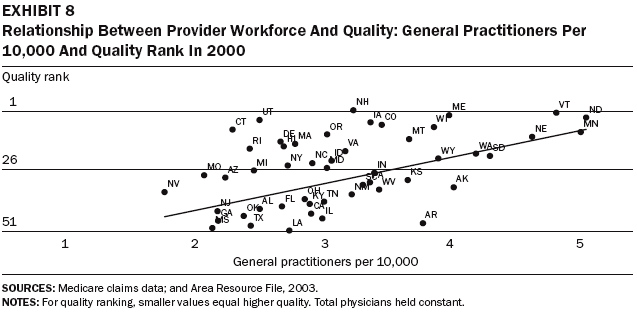
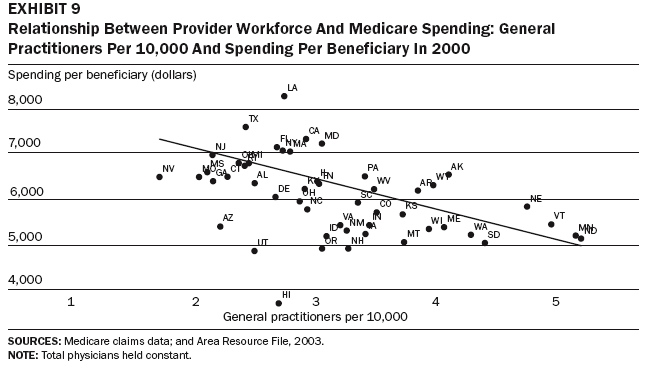
). The authors, Katherine Baicker and Amitabh Chandra studied the relationship between Medicare Spending, the type of physician workforce, and beneficiary's quality of care. The results were astounding, and showed that only one parameter correlated with improved quality and decreased cost, and that was the ratio of family physicians to the general population.
Click to Enlarge
These results confirm what has also noted all over the world, which is that high functioning health care systems have a high ratio of primary care doctors as part of the physician work force. The authors also looked at the affect of the ratio of more narrowly focused specialist physicians on cost and quality.
Click to Enlarge
The data clearly show that as the ratio of narrowly focused specialist doctors increases relative to the general population, cost goes up and overall quality actually worsens!

How can this be? It seems counter intuitive to many people that more specialists would result in lower quality of care. Based on my years of practice experience, I believe these results are accurate, and that the results are due to several factors:
1.) When family physicians are in short supply, needed primary care services, that should be the foundation of all that we do, are not received by many people who have their first contact with specialists .
2.) When family physicians are in short supply, they are forced into a mode of seeing patients more quickly than is desirable, which I believe lowers the quality and the patient satisfaction. Costs go up because it is easier to simply order the expensive tests that drive up costs than it is to do a detailed history and physical exam before planning workup.
3.) Due to their training and focus, narrowly trained specialists sometimes bring high risk and high expense habits to bear in situations where a less aggressive approach might be preferable.
These doctors are a valuable and needed part of our care delivery system, but they do not specialize in first access health care, screening and helping us to stay well.

The authors looked at other factors, but did not observe any other clear relationships. Data on nurses, for example, did not show a change with a changing ratio to population.
Click to Enlarge
So what does this mean for health care reform? To me, the implications are clear, and aggressive action is required. Health insurers and the federal government need to begin immediately to implement policies that nurture the provision of primary care.

Unfortunately, the current state of affairs is bleak. The American College of Physicians (ACP) has issued a 2006 report that predicts the imminent collapse of primary care in the United States, due to the inadequate and dysfunctional payment policies of the government and other third party payers. Most government payment programs do not even cover the overhead cost of doctors to provide primary care, and the situation is getting worse! Medicare, for example, is scheduled to decrease payments by 5.1% as of January, 2007. Fewer and fewer medical students are choosing to pursue family medicine or other primary care as a career option, because they know they can make more money at less personal risk by going into a high tech, limited specialty. Many existing primary care doctors are near retirement and will soon be out of the workforce. And all of this is happening at the very time we will experience a large jump in Medicare age patients needing primary care services.

The Medicare situation is due to the way payments to doctors are calculated. Medicare Part "B" was established to cover doctors visits. As care has become more technical and complex, new services have been added into the pot for coverage. Now, in addition to doctors visits, Par "B" also covers out patient surgery, CT scans, MRI scans, nuclear medicine and other high tech wonders. This then results in Medicare Part "B" spending "too much money", and payment reductions for everyone are then put in place. Primary care office visits get cut back, in spite of the fact that payment is already too low.

If we began a national policy of enhancing the ability of family physicians to provide excellent primary care, it would need to start by decoupling primary care payment from the rest of payment for health care. This would encourage the development of what the American Academy of Family Physicians (AAFP) calls the "personal medical home", a place where they know your name and each of us knows we can go for care and referral. Payment to primary care practices needs to be enough to cover overhead, build state of the art infrastructure to incorporate electronic medical records, support advanced management strategies and let the doctors make a reasonable profit. This will attract doctors to family medicine at the time we need them most! The data are clear. We need to nurture and encourage the only part of our current health care "system" that is already demonstrating a clear relationship to increased quality and lower cost.